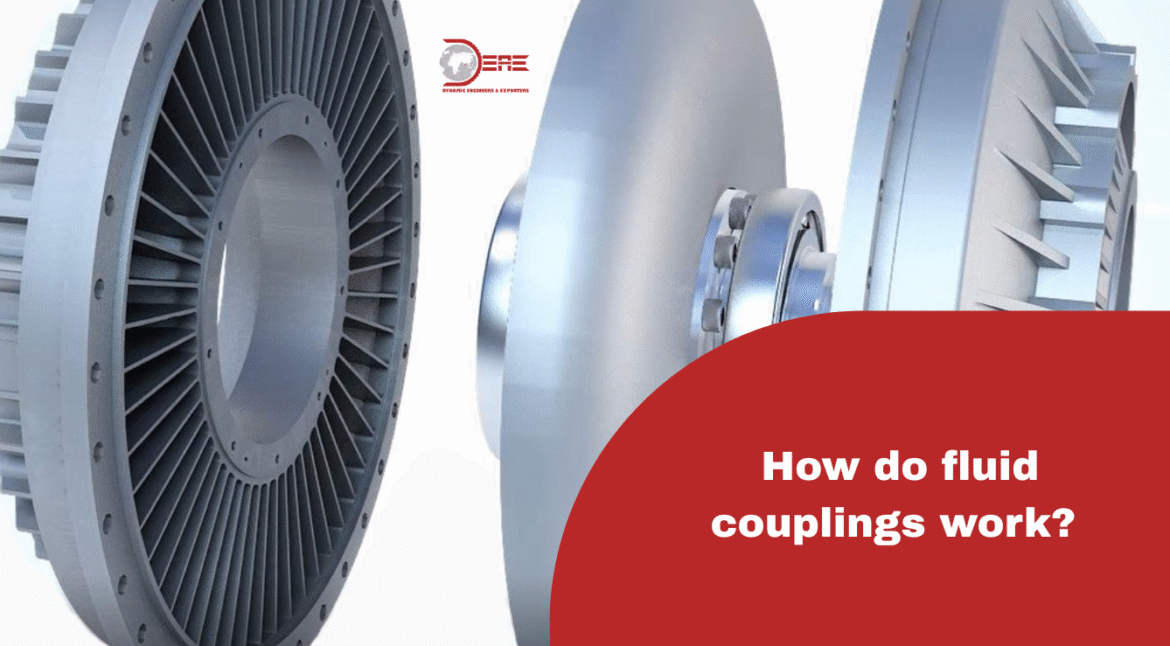
Fluid couplings work on the hydrodynamic principle to transfer power smoothly from a driving shaft to a driven shaft using a transmission fluid like oil. Here’s how this process unfolds:
The fluid coupling consists mainly of a pump wheel (impeller) connected to the driving shaft and a turbine wheel attached to the driven shaft, both housed in a casing filled with hydraulic fluid.
When the driving shaft rotates, it spins the pump wheel, which uses centrifugal force to propel the fluid outward.
This moving fluid transfers kinetic energy to the turbine wheel on the driven side, causing it to rotate and thus transmitting torque.
There is no direct mechanical connection between the input and output shafts, so the torque is transmitted entirely through the fluid flow.
The process allows for smooth transmission of power and controlled slip between input and output speeds, cushioning shocks and reducing mechanical wear.
This slip (difference in speed) is essential for fluid flow and torque transfer.
Fluid couplings can help prevent shock loading to the drive motor and driven machine, improve starting performance, and allow soft starting.
Depending on the design, fluid couplings can be constant fill or variable fill, allowing different performance characteristics for various load conditions.
In essence, a fluid coupling transmits rotating mechanical power hydraulically by converting rotational energy into fluid motion and back into mechanical energy on the output, providing smooth, wear-free power transmission with some slip for protection and control.