

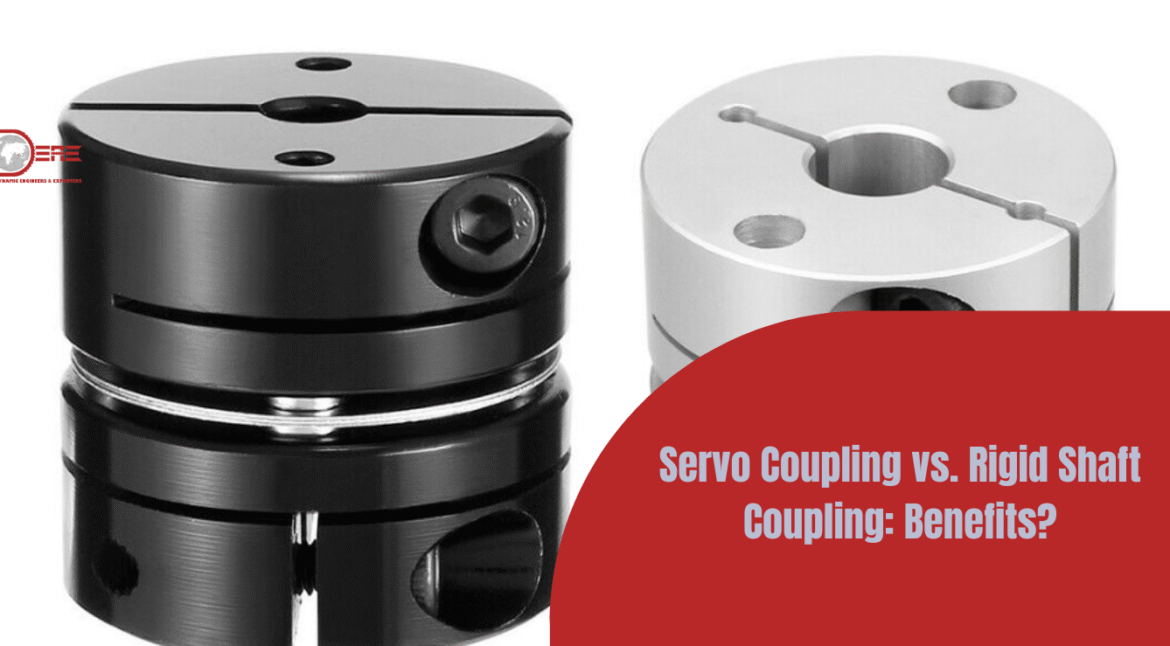
Servo Coupling vs. Rigid Shaft Coupling: Benefits?
For industrial automation and motion control, every component is critical to system precision and reliability. A servo coupling is one of the most underrated components, but it plays a critical role. Couplings link the motors to the driven equipment and transmit torque, allowing for misalignments within the system. Choosing the right coupling has a significant effect on the system accuracy, efficiency and durability.
In this blog, we explore what to look for in a servo coupling, its alternatives, and how to choose the right coupling for your use.
Understanding Servo Coupling
A servo coupling connects servo motors with other parts of the system. These couplings are used in high-precision applications, where even a slight deviation or backlash can impact the system’s performance. Ideal for robotics, CNC machinery and packaging systems, they offer excellent torsional rigidity, handle minor misalignments, and minimise the vibration transmitted.
They are usually lightweight and have a low moment of inertia, making them ideal in high-speed, dynamic systems.
The Role of Rigid Shaft Couplings in Motion Systems
On the contrary, rigid shaft coupling types provide a solid, strong connection between two perfectly aligned shafts. They are simple, cost-effective and transfer torque without play. However, they are so rigid that they cannot accommodate any misalignment, whether axial, radial or angular.
When used in systems where the shafts do not align perfectly, they add significant stress to the bearings and other parts, which may wear or break down.
What is Coupling Disc Technology?
Another highly effective option that most people are unaware of is the Disc coupling. The disc is made out of flexible metallic or composite material and transmits torque while allowing minor angular and parallel misalignment. This makes it highly suitable for applications that need high torsional stiffness without compromising on misalignment.
The coupling discs also offer zero backlash, an important consideration for positioning and indexing applications in servo systems.
Choosing the Right Servo Motor Coupling
When selecting a servo motor coupling, several factors must be considered. There are torque requirements, misalignment tolerances, operating speeds, and space constraints. The coupling should provide high torsional rigidity for precise positioning accuracy while also being able to absorb shocks and accommodate misalignments to protect the connected components.
It is also essential to be mindful of the temperature range, maintenance needs and material compatibility with the operating environment.
Comparing Servo Beam Couplings
One common subtype of servo coupling is the servo beam coupling. They are made from a single piece of metal with spiral cuts, and they are very flexible, offering zero backlash performance. It is designed to allow regular angular, parallel, and axial misalignments while maintaining good torsional stiffness.
However, they are not suitable for use cases requiring a high torque transmission, as their torsional capacity may be limited by material strength and cut geometry.
Why are Rigid Couplings Used?
Rigid couplings cannot tolerate misalignment, but they are accurate and easy to use. When the shafts are aligned perfectly and high precision is non-negotiable, rigid couplings provide unmatched torque transfer without energy loss due to deformation.
They are also compact and easy to install, making them suitable for simple, low-maintenance setups.
Types of Rigid Couplings Available
Several types of rigid couplings are used in the industry. These include sleeve or muff couplings, flange couplings and clamp-style couplings. Each has its own use case, depending on the alignment, torque requirement, and space availability.
For example, clamp-style coupling is commonly used in laboratories where adjustability and ease of assembly are crucial, whereas flange coupling is more suitable for heavy-duty power transmission.
The Hybrid Option: Half Gear Half Rigid Coupling
A half-gear, half-rigid coupling is a unique solution that requires a balance of flexibility and rigidity. This hybrid design typically features a flexible half-gear to absorb shocks and misalignment, and a rigid half for accurate torque transfer.
Such couplings are commonly used in heavy machinery, power generation units and large conveyor systems where conditions demand both precision and resilience.
Conclusion
Choosing the right coupling is more than matching shaft sizes. Whether you choose a rigid or flexible design depends on your system’s alignments, torque needs, and desired performance. Servo coupling is ideal for high-speed dynamic systems, while rigid couplings are ideal for perfectly aligned, high-torque systems.
Making the correct choice helps reduce maintenance costs, improves performance, and also extends the life of your equipment.